
 Geography
 Zuaan
A coastal region full of diversity and life. Famous for its fertile land, seafood, and rich salt deposits. The region is governed by a constitutional monarchy and is mostly peaceful, aside from the fair share of monster threats. Pab’Zuaan is incredibly culturally mixed. It was created by Swa, the South Architect, and it became a sanctuary for many. Swa was a very tolerant god and this rubbed off on their followers.
Overview
The southern coastal region is a diverse and lively place, with a mix of species. Pab’Zuaan is known for its rich cultural diversity. It was created by Swa, the South Cardinal, and became a sanctuary for many. Swa was a tolerant god, and their followers embraced this attitude. Modern Pab’Zuaan is vibrant and flourishing. The region specializes in agriculture, furniture, simple technology, salt, and spices. Zuaanians follow a capitalist system under a constitutional monarchy, focusing on the health of the economy and citizen safety. The leadership is led by a queen known as Journey, along with an appointed council of soothsayers.
Zuaanian architecture is colorful, with influences from Greek and coastal styles, inspired by the inner-city Torian architecture. Stained glass and clay-based materials are commonly used. The aquatic Zuaanian architecture is similar, but with thicker walls and a touch of an Atlantic aesthetic. Clothing in Pab’Zuaan is flowy, reminiscent of waves, with loose jewelry, translucent fabrics, and intricate designs. It bears some resemblance to Mankian attire. Relationships are open and valued, similar to the Galians, as Swa, the Architect of love and fertility, encouraged love without limitations. Zuaanians have a mix of religions, but the majority of the natives follow the Swavvel faith.
Notes
Pab’Zuaan’s royalty were the Oracles, who were powerful soothsayers that Swa appointed every few centuries. The Oracle was the technical monarch, but more as a theocracy. When Swa disappeared, new Oracles could not be appointed, so a merchant family took over and greatly removed the religious aspect of the monarchy. This change in government split Zuaanians into Swavvels and Vedluns, where Vedluns thought this change was like spitting in Swa’s face. Eventually, the Mellomora died out, a generation with no living children, so the lineage was forgoed and a new one was chosen by the populace. A Wylld was appointed as the start of the new royalty. Journey was a soothsayer from Bivnix, her abilities likely why she was chosen; to reinstate the oracle legacy.
Pab’Zuaan has a strong land and aquatic military. The brigade is led by a general and their right hands, who handle soldiers, guards, patrollers, and mercenaries. Seavelle and chislier cavalry are common. The brigade also employs a group of loyal soothsayers that work to predict catastrophes, especially natural disasters and oceanic threats.
Geography

Chaarm Bay
Filtering into the mainland's southwest corner is a large bay with crisp teal waters. This bay used to be a massive lake before the sands were washed away and the freshwater mixed with the southern ocean. The bay is full of sea life, underwater caves, underwater geysers, and of course protects the underwater portion of the kingdom; the main city itself. Waves are never too rough here, and the ancient colossal who once served Swa still resides, swimming peacefully among the unmoving waters.
Chaion - Capital
The capital city is located on the west side of Chaarm Bay. Half of it is below the waters and half of it is on the coast. The deepest, most protected section of the city is beneath the seafloor. The inside of buildings is filled with air (enchanted), so any species can live there, but it certainly takes some bravery. Its architecture varies as you travel from the Greece-like coastal city and into more of an Atlantis round-top style underwater. The buildings smoothly transition between land and sea through air corridors. Zuaan capital is a highly advanced city with a lot of culture and traditions still standing strong.
Hailing Cove
Towards the southwest cliffside zone of the bay are many water-carved caverns, some massive enough to house multiple karkadann herds. One of these caverns has been settled as a nice seaside town for more fishing, only to be overcome by the ancient storms of the past. The black market took over the town, protecting it from the rest of Pab'Zuaan so their people could conduct their business and live in peace. It is a dangerous place, however those who show desire to live in the quiet, nice town are granted permission and safety from those in charge.
Herundiin
Herundiin is the only known living colossal from ages long past. They do not speak, they merely wander. Their shell is always above water, an island and ecosystem formed upon it. The moving island is lush and protected by law, with the only building on their shell being a small, beautiful palace where important gatherings are held by the Zuaanian government.
Oracle Palace
Built on the traveling back of Herundiin, overlooking the sparkling turquoise waters of the ocean, stands the Oracle Palace. It is a work of art, with towering white walls and graceful arches that create a feeling of airiness. The palace is surrounded by lush gardens filled with colorful flowers, exotic plants, and swaying palm trees. It is known for stained glass windows, among the largest and most intricate in the world. The windows stretch from floor to ceiling, depicting scenes of tropical landscapes, mythical creatures, and historical events. The sunlight filters through, casting a rainbow of colors across the palace's ornate interior. A symbol of luxury and opulence, finely crafted marble floors; The rooms are spacious and airy, with high ceilings and large windows that allow for plenty of natural light and fresh ocean breezes. The palace's many balconies and terraces offer stunning views of the surrounding island and ocean. Despite its grandeur, the palace is also a place of history and culture. It houses a vast collection of artifacts and artworks from around the world, ranging from ancient statues to modern paintings.
Veduro's Ancient Vision
Veduro’s original temple was a large mansion in the plaza of the original fishing town they created for their first followers. This town is extremely run-down and uninhabited, much of it washed away by the ocean. What remains of the mansion is protected by sandbags and spells. It is in-tact, but unsafe to wander within. Most of Veduro’s items and journals have been removed and placed in safe storage or museums.
Azure Botanical Museum
In the Zuaan underwater sector is a stunning botanical garden. It is a sprawling complex of interconnected domes, each containing a different ecosystem and collection of plants from around the world. Anyone entering is struck by vibrant colors and fragrances of the flora. Sunlight filters in through the glass domes, casting a warm glow. Winding paths and arching bridges, tranquil ponds and cascading waterfalls. Towering trees and delicate flowers, exotic fruits and fragrant herbs, all thriving in the carefully controlled environment of the garden. The garden is also for scientific research. Biologists and botanists work tirelessly to study the unique challenges of growing plants in an underwater environment, developing new techniques for growing food on station Zariel and cosmic colonies.
Ulhar Caesin
Bright, tall, bubble-topped blue trees extend across the landscape below the slopes that the Unity River separates. The Ulhar Caesin translates from ancient Draconic to blue forest, which is certainly true. The Ulhar is known for being mostly safe to live and explore, with the only common predator lurking being the lazy boslodons. Lots of bioluminescent mosses and ferns grow on the ground and the plants that seep nutrients from the trees resemble coral that has evolved to live on land. The forest often has a fog littered throughout the spring, creating the effect of appearing underwater when one roams through.
Ulharshore
A large town settled among the depths of the Ulhar Caesin. This settlement is quiet, independent, and is full of families who have been there through generations. Bubble trees surround the area and a calming teal fog covers the town both day and night, however during midday it is thin enough to see a decent distance. The buildings are typical Zuaanian, colorful architecture.
The Refuge
Nestled in the dense forest between Pab’Zuaan and Sequ’Manko is a broad campsite originally founded right after The Raining Fire to house Mankians escaping the violence. Nowadays, the Refuge retains its purpose for helping those with nowhere to go. Funded by both donations in Sequ’Manko and loans from Zuaanian royalty, those who work there care for adults and children alike who need to regain their footing.
Continental Abyssal Zone
Deep within the ulhar caesin is the continental abyss zone. A deep, rifted fault zone where sunlight struggles to reach. The underwater effects of the caesin continues here, even as it becomes pitch black. The force of water is crushing, special equipment is required. What seems like the floor of the abyss is actually reflecting water, but once broken through, things get weird. Open air, but no gravity. The crushing weight has vanished and bioluminescent flora and fauna surround everything. Within the abyss zone is a rare species of seaweed. It thrives without sunlight, feeding on aura-rich chemicals. It is pitch-black, slimy, and has a glowing stripe down its center. Called caro deorum (“the flesh of gods”), it has unusual anti-aura properties. It is used to make clausa; an expensive medication that is used to rid conduits. It is toxic and drains bodies of aura, slowing systems to a halt, easily killing without medical assistance. It’s used to detach parasitic shadows, removing their ability to feed.
Swali Shores
The calm beaches of the southwest. Swali Shores is a large inlet of sand that circles Chaarm Bay, along with many small islands encompassing the turquoise sea. These shores are home to many beachside towns and boat docks, farms, gorgeous Chaarm architecture buildings, and in the distance the edge of Psolla peaks can be seen through the clear skies. Storms of waves and wind hit the coast during the spring, but during the summer and autumn the towns are a wonderful place to live.
Bivnix
Bivnix is built around the edges of the bay, with docks to pull supplies in. Architecture is oddly bulbous, based on the forest, and the primary material used is the dark woods cut from the abundant trees and clay from the seabed. Extremely colorful villas and beautiful stained glass, the people here are very diverse. Bivnix is controlled by the Zuaan of the territory, but with the slight distance, the community has more so established their own way of life aside from trade control and central laws remaining by force. Bivnix is known for being one of the most open and fun places to live in Ptitheros, as so many cultures and holidays are hosted in one place with an easy-going monarch watching over.
The Storm Wall
In the past, a terrible tropical storm attacked the bay, destroying many homes and lives. In an attempt to salvage things when the kingdom was warned by the shamans about the oncoming storm, Zuaanians constructed a shielding wall from whatever they could find. Constructed to shield the coastal side of Bivnix, it failed miserably and has since remained near the shore as a crumbled shambles of its former self.
The Wurunwa
Sometimes called the Wurunwa Evergreens, this massive forest is remarkable for just how many incidents and missing-person reports arise from those who travel to it. It is a place full of unstable aura, likely the cause of the towering trees, and anomalous properties run wild. But the most concerning piece is what roams these woods. Wurunwa is a dedicated soyo-grave, a place where misformed lindosts, called "soyowas" are sent to wander. These monsters are extremely dangerous and unpredictable. Despite this, there are rumors of a community living within Wurunwa, and it isn't the outer werebeast camp.
The Distortion
Once the location of a global callpoint, the ancient architectural marvel has since shattered, its materials lost deep into the dark soil. Its energy remains, pulsating invisibly through the section of the redwoods. Its heavy aura draws in wanderers and monsters alike, its sense of dense calm truly signifying calamity when a Ptithian is drawn in.
Wyldbeast Caverns
These caves range in size, many are large enough to comfortably walk through. Stalactites line the ceilings of vast tunnels, suspended and hazardous. Sinuses filled with water gather in pits and underground rivers. The oxygen levels are low and survivability is difficult due to how easy it is to get lost. Thousands of jewelbels (glowing auravore beetles) migrate into the caves each year and cover the ceilings. It is a dazzling lightshow stretching throughout the caves, but the occasional talonmimic interrupts, sending the jewelbels scattering.
Clan Nightcrawler
Even werebeasts cannot challenge the forest, but they have chosen to inhabit its outer edges. Settled on the edge of the Wurun Waterway where it sprawls out into the ocean is a settlement built into the tall trees of the forest. Trunks are hollowed out and homes are connected by strong bridges, some places even reside in the expansive roots of the trees. These clan members tend to be anxious, simply because of the forest's influence, and live mostly in their natural form. They are constantly dealing with soyowas attacks.
Kandle Bog
Mucky, wet, and full of mangrove swamps. Kandle Bog is covered in a misty shroud but is bustling with life and the soft glow of thousands of foes. It is a peaceful place, a place that will never attract the rich or dainty, leaving its residents with a simple life that has remained the same for centuries. Many ancient Ola'mel family groups call this bog home.
Woarii
The southeast peninsula is home to the Woarii clan. When the Aurix clan fell apart, many members migrated south to escape and start anew. The peninsula had lush forests and rocky mountains, and any settlements it once had were merely ruins. Over the years the clan grew in size from more migrators from all over Ptitheros coming in. They stabilized their governing systems and built a nice city within the colorful canyons and caves.
Overview
The Woarii clan lives in the southeast peninsula. The Aurix clan broke up and many members moved south to start over. The peninsula had forests and mountains, but no existing settlements. Over time, more people joined the clan. Modern Woarii sticks to old-fashioned ways of life with less technology. They focus on survival as a community and only interact with other territories when needed. They export things like food, seafood, wood, and artifacts. Their economy relies more on trading than money. Most people in the clan take care of themselves. They operate like a big wolf pack, aiming for sustainability and protection. The clan is led by an alpha, currently Mylli, and the elders choose the next alpha.
Woariian buildings are large, underground, and sturdy. They're inspired by Chaverian and Galian architecture. Woariians don't have a specific style of clothing, but many wear teal or blue ribbons or flags to show they belong to the clan. They believe in raising children as a community. The Woarii clan came from the Aurix Clan, which had a lot of Sagekin members, but no single religion dominates their culture.
Notes
The region has seen its share of outcaste groups. Ruins of long-forgotten settlements and artifacts are scattered across the peninsula, some dating back to before the rise of the first dragon kin. Beyond this forgotten era, the Woarii clan settled the region again and has since kept it alive as a recognized territory.
Woarii labels rank as they would be referred to in the old language of Draconic, which is long dead in present-day Ptitheros. They have a strong tradition to keep Draconic language alive where they can.
Geography

Eastern Jungle
The Eastern Jungle is an unclaimed territory zone filled with lush greenery and massive trees. In the undergrowth, it is dark, a place of danger, but there are many copses of trees surrounding areas of grass and large flocks of foes that go about their meaningless lives. The canopy is no stranger to tree-houses of those who like to live off the land, and caverns weaving between the mounds of dirt piled between old trees are common.
Volcanic Inlet
The eastern ashland is a volcanic set of islands sprouting from the eastern shoreline. The winds are hot, sharp, and bite at the black sands of the islands, forever pushing them outwards into the sea or up the docile mountains. The main volcano on the central island on the chain is known as the Melder's Volcano, due to the many stories of it once being His preferred home.
Olmashen
When the Ola'mel controlled the desert and Meldr'uno was active in their eastern dragons' lives, there was the Ash Council. A group of powerful solar pyromancers who served their god loyally. The council and their Architect dwelled in the volcano, one with a massive golden temple. Nowadays, the heat of the volcano makes the temple almost inaccessible for study or to recover relics. Regular heat and fire resistance is not enough.
Kandle Forest
Most of the island is covered in lush, turquoise and deep green, temperate forest. A place of wondrous hunting and secretive discussions. The forest is full of life and full of dangers, never are children allowed out into the trees without a parent or family friend to guard them, as monsters screech and echo throughout the leaves at night. The forest covers the northeast corner of the Southeast Peninsula and into all the creases between the Falls and the Crevasse.
Kitte - Capital
One of the two most bustling places on the peninsula. The Kitte Crevasse is the hustle of above-ground activity and caters towards all, such as homes higher up, nestled into the cliffs, others closer to the bottom of the chasm for those who are restricted to the hearth. The Crevasse extends from the northwest edge of the island to the southeast, smoothly it curves upwards and transitions into more flat land where the forest takes over more just before the marshland does. The rocks that line the inner chasm are naturally very jagged, with minerals showing and weak covering from the talons that had begun to scrape and carve at them in due time. As stone was stripped away near the top and trees were cleared or pushed back away from the cliff rims, the Ptithians that inhabited the island had started their endeavor to create their first settlement there- and so they did just that. From a small campsite to hollowed out caves for them to take cover in during rainstorms, the settlement has evolved into something much more with history rooted down to its very beginning tent stakes in the ground. The entire northern half of the Crevasse is populated, the buildings; platforms made of wood that lean on the rocks and use stilts to keep them up against the edges. Turquoise tarps and wraps string the roofs together and baubles such as foe lanterns and other pretty jewels drape from corners and chime in the breeze that blows past. Ladders, ropes, even stairways have been carved into the stones themselves to allow easy access to the upper levels. Off the ground, the platforms and better viewpoint can make any creature feel safer. Where the platforms of wood and roofs of tarp stop, digging begins. The cliffs are dug out but retain their very top layer of stone and dirt, columns of rock are left alone so none of the dwellers' work becomes undone or the world literally crashes down on a Ptithian's head. Pockets, little dens for individuals or larger ones for families are strewn all throughout the inner cliffs just inside the tarp buildings, with crystals that pulse a magnificent blue or torches are hung all around to cast a glow to illuminate the artificial mini-caves. Ptithians fly through and across the crevasse constantly, hopping from market shop to market shop, home to home, everything and anything can be found in the crates or barrels that are left on the platforms by the shopkeepers after they head back home to their respective den.
The Archlen
A towering stone structure made by creatures of the past, its original base of crumbled ruins and mossy orb was already there when the pack's ancestors came to the peninsula; whoever had put it there was long gone, but they were still very curious as to who was the creator. Perhaps the Melder himself, that would certainly be something to overanalyze if need be. The intuitive Woariians rebuilt the Archlen over time, a decade or two of carving and crafting new ideas as to how to infuse aura back into the blue orb that had been pressed into the hearth. However, inventive spells were unnecessary, all it took was one dragon with a childish idea to simply fly the heavy orb up into the circular hole that the archway held once it was put back up again- it tugged at the dragon's arm and flung itself into its proper position, where it began to pulse and float, bobbing lightly until it stabilized and a relaxing aura flooded the researchers nearby who were building or working to fix it. A thank you from whoever created it long ago, maybe their spirit is free to watch over its land again, the clan members may never know.
Endearing Falls
A busy spot on the northern end of the peninsula, the Falls are indeed a cool rush of gallons upon gallons of water tumbling off the side of a cliff from a river and into another river far below. The rushing water has caused the cliff it courses over to become more indented, curved within like a bowl with ledges where moss and slippery stones have stacked. Dwellers like to perch on these ledges and let the crisp and refreshing water stream over their skin just before they fly off back home or stay awhile in the pooling river curvature below with some friends to relax. Although the start of the river comes from the Southern Sea and begins with salt water, the underground filters backlash it by entering underneath from the other side, this results in a mixed briskish solution by the time the water hits the waterfalls. So those with scales sensitive to seawater don't have to worry too much and can still enjoy themselves in the pools like everyone else. The waterfalls got their name from the first settlers, who saw them as the original crossing point into a new "endearing" life away from their former homeland within the Aurix Caesin. The name struck and is still the title the waterworks retain, despite most residents just referring to them as The Falls.
Hovering Memory
The name derived from the location's undesired effects, the Hovering Memories is a patch of mid-height floating islands on the southwest end of the island that harbor the densest forest area of the land and the thickest vines holding it to the ground below. The Woariians built chains to keep the islands together and close, not wanting to lose such an interesting part of their territory. Pieces are detached, the ground is shaky and uneven, cracks could appear anywhere, so it's not a safe place for Ptithians to go if they lack the ability to fly. On the largest floating piece is a jutting crystal, deep turquoise, from the ground that splinters into sharp edges and spills into small ones all around it. Like a dangerous throne, the crystals show almost perfect reflections of anyone that steps near it, they show the observer memories of their past, usually ones they don't want to remember, and through their eyes the crystals shows those memories on its surface similar to a phone screen, so anyone can see the deeds of their brethren. It's a useful yet dastardly thing.
Guawsyvern
An exact translation from Draconic proves these flattened upper landings of the island are special to the creatures that inhabit these territories. Cliffs of Dreams, the Dream Cliffs, these wannabe mountains make up the area in between the Crevasse and the Hovering Memories, the southwest zone of the main peninsula. These cliffs are where Woariians take their young to teach them to fly.
Spiral Marsh
A natural phenomenon, the marsh is a beautiful site of water coursing and trailing through the loose white sands that creates swirling streams that intertwine all back together to go back into the sea. A place of Zen, the salty water is inviting and warmed from the sun constantly hitting the shores. Found on the east side of the island, the marsh is easily accessed from the paths that leave the southern end of the Crevasse, or flying proves an easy way to spot the area as well when above the large temperate trees.
Nairuuthli
The first entrance to the caverns is a smooth transition of gravel that has an entrance point in the chasm just in between the West side of the Crevasse and Hovering Memories. A slide or surf down the loose sediment opens up into the Nairuuthli caverns with the Stepping Stones being the nearest camp. The second entrance is a hole in the ground big enough to fit through that is found by the river of the Endearing Falls. This entrance drops straight down into the foliage of the Ulhar Corner and is the least used entrance into the caverns. The third entrance, although treacherous for Ptithians the first time, is a rift at the bottom of the shallow sea zone just northeast of the Tailstrike Shores. The entrance is underwater, but it can easily dive into and it shoves those who go in back into the air of the cavern the second they spill down the waterfall of saltwater, where they can find the Plaza room just one tunnel down.
Pack Plaza
A busy spot, the widest room of the caverns, it has been carved and dug into over time by the Woariians and has been crafted into one of the two most dwelled in areas on the island. A roughly circular room with an entrance to the west and another entrance that feeds in from the ocean a bit to the northeast based on the center point of the cavern room. Like the Kitte Crevasse, dens and family caves with platforms and tarps to function as walls or blinds are all over the walls of the room, with almost as many residents that can be found above ground. Light spills in as a blue hue from the ocean entrance just past the nearest room where the Ptithians can gather water to boil the salt. The plaza zone is deemed the safest place on the island and within the caves, so it is the haven for many clan members.
Bramble Verge
A dense rock wall away from the plaza, the Bramble Verge is the second small campsite and den area of the caverns past the Stepping Stones. With two streams of water spilling in and into shallow pools on either side of it, it's a quiet and serene place for anyone to live if they want to be just a bit out of the other's way. Many of the gatherers of farmers live here since it supplies spare dens for storage and easy access to the forest in the Ulhar Corner, just a tunnel northwards. The area was named after the dense vines that web across the ceiling of the cavern room.
Stepping Stones
A broken segment on the western side of the caverns, the stepping stones are pieces floating above an endless drop into the darkness below. Few have ventured into the abyss of the caves, and even less have returned but they refuse to talk about what they found or observed. Enough light spills in from the Slope entrance to hit the stones and spare torches or fire pits create the rest needed to navigate, so those without wings can easily hop across without trouble, for the most part. On the highest shelf sits small burrowed caves and pitched tents affront them to block the whistle of wings that blow through the caverns up from the abyss. A few dragons live there, mainly those who like solace and don't want to sleep around the others of the pack within the Plaza or the Crevasse.
Caves of Time
Far, far below the void of the Stepping Stones is a cavern with anomalous properties. Gravity goes away once one goes deep enough and a mist grows thick and looks like the cave is full of nebulas and stars. Ancient architecture is scattered throughout, in a style similar to the Hovering Memories. It is not a known architecture style and has carvings written in an unknown language. It is speculated this is another lost city of the Collosals, but the buildings are too small for this to be true.
Soll
A mini-continent in the southern ocean. While not a kingdom, Psollo is often used to describe the "territory" name of settlements in the region. The Psollo region began with Kilaan being founded as a fishing town and export location for said fish and rich timber.
Overview
Psollo is a mini-continent located in the southern ocean. While it's not a kingdom, the name Psollo is used to refer to the settlements in the region. It all started with the founding of Kilaan, a town known for exporting fish and timber. The proper Sollian population came later, after the Vedlun migration a few decades after 4700 CE. Psollo was a modest territory for many years, but now it's thriving. Modern Psollo is an advanced and resilient territory. It specializes in ice, freshwater, metals, minerals, fish, tourism, and technology. They follow a market-based socialist system under a strict democracy. The leadership consists of two presidents, Sashok and..., along with a council of professors and scientists.
Sollian architecture is sturdy, simple, and picturesque. Many citizens live in robust cabins, incorporating warming spells and thermal runes during construction. Some homes are even built into mountain sides. Clothing is designed for the cold weather, with furry coats, sweaters, stockings, shawls, and portable thermal runes. Relationships are closely tied to strong communities, and it's common to have godmothers and godfathers across families. Psollo has become one of the most culturally diverse territories, as its population consists of non-natives. The majority of the population practices Architectism to some extent, which means they follow more than one god. The territory started with a predominantly Vedlun population.
Notes
Psollo allows no royal nor noble classes. The government higher-ups are composed of a council with two presidents that gets democratically voted in every decade. These authorities are usually professors or scientists rather than anyone in the political field. This makes Psollo both the easiest and hardest to work with when it comes to discussing with other governments.
Psollo was a land for crazy adventurers until 4700 CE. The tundra was unforgiving, but the northern coasts showed promise. The first settlement, Kilaan, was originally just a fishing town. They were a sturdy, strong bunch of ptithians who had their roots in Architectism. Eventually, the population of Kilaan skyrocketed due to a large migration from Pab’Zuaan and Sequ’Manko. Due to the Vanishing event affecting Swavvels, the Vedlun sub-affiliation wanted nothing to do with the new governing body and dictations towards their older religion. The Vedluns were tired of Swavvels telling them their belief in Swa being alive was wrong, so they migrated to Kilaan to continue their own cultural quirks. Kilaan spread further out, farther away from the frozen coast, and into the dry mountains dense with pine trees, aspens, lichen, and shrubbery. As Kilaan developed, Sollians pushed further into the mountains. The range offered a great supply of iron, precious minerals, and frigid freshwater. These gains proved to be an excellent export for Psollo and the new city of Howland was established in the mountains to make better use of it. Venturing past Howland was difficult, only a barren tundra made up the landmass beyond the forested mountains. Still, Hawlbrus was eventually established on the southern coast purely for oceanic exports and scientific research. Due to Psollo’s conditions, Sollians were always enacting possible solutions to stay warm and safe. Education, magic, and technology have always flourished in the culture and cities, building a foundation for the college of Wolven and delicately designed cities with plenty of opportunities. Tourism and science are the largest draws for new Sollians.
Geography

Timberland
A vast taiga forest full of giant pine trees and cold-loving, bushy ferns. The timberland surrounds the bay where the Kilaan City and its ports reside and pushes inward towards the northern side of the Howling Mountains. The ground is soft with snow and pine needles and hidden, icy waterfalls are found around every corner.
Kilaan - Capital
Originally a dock town for exporting and transporting the mining and fishing industries that brought in plenty of goods to the mainland, eventually the outpost developed into a small town. As years went by, Pab’Zuaan had a large migration soon after the Vanishing event in 4700 C.E. This large migration was composed of Vedluns who were tired of the Swavvels ignoring their idea that Swa was hidden or captured, so they left to form their own area where their community would be respected amongst one another. The population increased and Kilaan spread further out, farther away from the frozen coast, and into the dry mountains dense with pine trees, aspens, lichen, and shrubbery. A winter wonderland, the city is called, its architecture a wondrous array of log cabins in every shape and size, many large buildings looking like ski lodges or logging camps. The weather is cold and unforgiving, but the Ptithians who live there do not reflect the weather in their personality; rather, citizens of Kilaan tend to be passive and happy, going about their days one step at a time.
Howling Mountains
Cold from the base to their peaks, the Howling Mountains cross Psollo and protect the settlement of Howland from dangerous winds blowing in from the tundra. Flying over their peaks is a dangerous quest, their winds are so violent that they howl like wolves and can freeze a Ptithian's wings solid.
Howland
Howland is built with homes being vertical patterned dens that start at the base of their mountain and crawl upwards on the rocky walls and cliffs. The city has a good supply of iron and precious minerals, along with freshwater in abundance that is melted from the frigid peaks of the mountains. The people of Howland, although tough for being able to live in such a cold climate, are not a rigid bunch; most are content and happy with their lives, their daily tasks are simple and repetitive. Howland was originally established as a small encampment for the cold-preferring Ptithians from Pab'Zuaan who sought a new home far away from the bustling Pab'Zuaan capital back during the Vanishing. As centuries turned into eras, generations continued on and on, the town of Howll was eventually claimed under the territory of Kilaan. Once Howll was claimed, without protest either, Kilaan renamed it Howland and from there it was simply a steady increase of population growing and better resources being traded in and out from the cities.
Icebracc
The entirety of the south pole’s expansive ice continent. There is nothing but snow, ice, flat lands, and wind spiraling in a powerful anti-cyclone. Nothing lives here permanently, the only life being seavrons lounging on the glaciers that float away from the tundra coastline cliffs. But, a strong aura flows through its grounds, making scientists consider if more life flourishes in the deep underground of the tundra.
Hawlbrus
The farthest south civilization in Ptitheros, extremely close to the south pole, Hawlbrus is a dangerously cold outpost village where a thin population of people lives. Some are actual residents whereas others are scientists who only stay for a temporary amount of time. There is nothing but a glacier tundra for miles around. Most resources are imported over sea.
Glacial Abyss
An abyss of ice foretold in ancient texts to be the resting place of a Colossal assistant who had collapsed into the frozen ocean long, long ago. The abyss stretches deep into the glacial tundra that covers Psollo, with jagged spikes sticking up and inwards as if a meteor had struck it and sent shards spiraling everywhere. Lots of scaffolding and mining has created pathways down into the blue darkness, and a few dozen meters down it becomes pitch black aside from foe lanterns and dust lights were strewn about. Relics from the distant past, pre-history even, reside encased in the ice deep, deep below, making the abyss the most prized place for paleontologists, geologists, and archeologists. Fossils from long-extinct creatures, scriptures written in symbols older than Draconic, things that existed before the E.D era are a great mystery to Ptithians of the present day.
Nox
To the north, steampunk-esce region among the large floating islands of the north. Highly populated and without any focus on religion, Nox specializes in mechanical marvels and expert scientists and teachers. The region is governed by a democratic council, headed by a mayor. To the south, a quieter, nomadic region, not owned by any central government and is one of the oldest areas settled by wanderers who left their kin territories during the mid-E.D. Era. It extends slightly into the North Shrine Plateau. Its main city has a noble family that handles most of Braeyc's economy and market management.
North Overview
In the floating islands of the north, the primary inhabitants are rubasyns who have a strong focus on technology. Instead of being created by a god, the people themselves formed a secluded republic out of fear of the Sage and worked persistently to advance their engineering skills for self-defense. Modern Nox is highly advanced and strictly secular, with renowned engineers and inventors. Other territories envy Nox since it opened its doors. Nox specializes in science, unregulated markets, aura technology, textiles, and valuable metals. Due to its location, Nox relies on imported food and raw materials. Mayor Mayzon and a democratic council lead the nation. The northern Noxians are capitalists under a republican system, with a focus on technology and the economy.
North Noxian culture features Victorian and Roman-inspired architecture, showcasing richness and intricate lace designs. Clothing follows a Victorian style, with laces, ribbons, buttons, and collars. Hand-made tailoring is common. Relationships are typically monogamous due to the high value placed on inheritances. Religion in Nox is the avoidance of religion itself, with most people being Unaffiliates.
Notes
While mostly a republic, Nox does have some oligarchical features. High status scientists make up the government council called The Lace. It is the central, opinionated group. There are many other government positions and lower councils for certain specialties such as economy or education. The top position is the seat of Mayor, who is elected through a popular democratic vote. The Mayor is also a figurehead for Nox.
Nox also has a collection of battle-automatons prepared in case a full liege is necessary.
South Overview
In the Thorn Alcove, located south of the floating islands, there is a collection of settlements. Braeyc is the oldest area settled by people instead of gods, holding a rich history. It is a diverse region with no dominant population or specific religion. Wanderers seeking distance from the gods created Braeyc, and it was the first territory where different cultures and creatures intermixed. Braeyc has managed to stay away from conflicts and politics, focusing instead on maintaining a strong economy and independence from other governments. The markets are overseen by a prominent merchant family, led by Noble Aremani. They have a service-based economy under a decentralized government. They prioritize independence and sustainability. The architecture in the south, sometimes referred to as old-age Noxian, is Romanesque, reflecting a rich, cozy, and relaxed style. The clothing style is less extravagant, with jackets and cloth wrapped around feet, hands, and joints. Southern Noxians have a higher percentage of polyamorous relationships and the highest rate of child adoption.
Notes
The top noble house of Braeyc is headed by a large dragon named Aremani, who has a harem of partners (male and female) and many children. Her family line goes back to the founding of Braeyc. Her family and other noble families in Braeyc are not royalty or connected to any politics.
Within the 200 - 1000s' of the E.D. Era, the main cultures and Affiliations of the growing world had developed, meaning the hard work of creating identities and traditions that the Cardinals needed their kin close by for were complete. The outside world had no boundaries, and these dragons (and gryphons) felt inclined to explore the unknown. The drive to see something new was strong to many, the rest of the world was at their fingertips. Cultures and species intermingled and smaller settlements were founded outside of the center three kingdoms, making places where cultures and identities mixed, dragons and gryphons mixed, the various different types of dragons seen on Ptitheros today mostly came about first during these centuries of exploration and new foundation. Although early dragons and gryphons founded the towns in the Braeyc territories during the E.D. Era, it was the rubasyns who grew the settlements into places larger than villages. Much of the population moved to the Floating Isles when it was discovered, but old families of Chaverian rubasyns can still be found in Braeyc. Braeyc developed into one of the most culturally mixed regions. It has remained out of conflicts and politics, but keeps itself together with a strong economy and focus on independence from other governments.
Because the region is extremely lax on religion and laws, it attracts concerning activity. Shadow worshippers and the 5th Cardinal are more common in the territory than any other. The 5th Cardinal organization lies deep within the Verge and the small management of Braeyc does not care. The "god" that Occult worships did not set up the camp. There is no reasonable proof the god they worship is real either. Their group existence is well known, but their location isn't, since the Verge and surrounding alcove is massive.
Geography

Floating Islands (Central & Outer)
The central islands are the largest. These temperate lands boast a wide diversity of plants with very little amounts of animals aside from fliers and windcatchers who managed to reach the skies. The middle island holds a large hole that drops its dirt into the ocean. A massive wind vortex, salty with seawater, spirals up into this hole, which allowed the early gliding rubasyn explorers to reach the island to investigate. Hovering closer to the ocean, the outer islands display more waterfalls and scenic landscapes. These smaller islands are used as farmland for Nox, but much of it has been left untouched.
Steam City - Capital
Nox is a large floating island off the northern coast, just above Braeyc territory. Much of the inner island is filled to the brim with Victorian-esce architecture and aura-powered industrialization, such as commodity factories and capsule plants. On the east edge of the city is farmland and open fields that cover the smaller floating islands- quiet cottage life is prioritized here. On the west edge of the city are larger and more spaced-out buildings, all leading towards the capital government building that sits next to the Whirlwind that rises from the ocean to the island's top. Life is non-stop in Nox, but the beauty it holds outside of its busy central city zone is worthwhile.
Underground Heart
The Underground Tunnels can be found all over Steam City. They carry energy(aura) and steam from production wheels to power the city and have dark walkways so technicians can access everything. So many sections of these tunnels have been lost due to explosions, cave-ins, and monsters taking up residence within them. One of these older sections was taken over by the Lace-Ups and turned into an impressive headquarters that is excellently hidden away from all eyes. An orbital section of tunnels around a centerpiece; a massive pit into nothingness where the Machine hangs above. Shaped like a biological heart with massive tubes and a silent hiss, it has long sat dormant. In the orbiting tunnels are various rooms outfitted for research, captivity, sleep, meeting, leisure, discussion, sparring, and so on.
Fox Isle
Fox Isle is a smaller sector of the Nox Capital located slightly south of it. A moderately sized island in the North Ocean, birthed from a submarine volcano that has long since been dormant. It is the middle ground between reaching the mainland from Nox and back, handling much of the marketing and goods traveling via ships and blimps. Because of this, the isle is home to many merchant families and dock workers, along with those looking for a life that is very straightforward with an even lifestyle of natural and industrial.
Sunken Night Sector
A mechanical city, glowing with neon lights and metallic surfaces, deep beneath the surface of the ocean between Fox Isle and the horn of Thorn Alcove. This underwater sector is a marvel of technology and engineering, built to sustain life and protect its inhabitants from the crushing pressure of the sea. Descend into the city and there are buildings made of a sleek, metallic material that resists the corrosive effects of saltwater. Tunnels made of reinforced glass, allumnix, and natural materials like tree roots connect buildings together. Metal rods cascade into the dark abyss, holding the tunnels up. Some of these tunnels contain trains that travel up onto the surface of Fox Isle. There are aquaculture farms, producing fresh seafood and plants. Although the environment is extreme, the sector took inspiration from the original underwater architecture of Zuaan Capital to ensure it stands strong against the currents. A mix of engineering and magic spells is used to keep the sector breathable and invisible to most wandering marine dangers.
Near the Sunken Night sector lies a trench. A dark and foreboding place with depths that even the most advanced technology cannot fully penetrate. It is a place of danger and mystery, powerful currents and shifting tectonic plates that make navigation treacherous. The water here is colder and darker than in other parts of the ocean, and the pressure is crushing. The only light comes from bioluminescent organisms that cling to the walls and drift through the water like ghostly apparitions. Marine biologists dream of studying the organisms within the abyss. Exploratory divers never return after spelunking within the abyss. Monsters with sharp teeth, venomous spines, and hold-fast tentacles lurk in the dark waters. Sightings of seatechs are frequent.
Sellesaut
A small island off the coast of the barren lands of Pselle, Sellesaut is the Iceland of Ptitheros; a strange little world contained within itself where warmth radiates from underground volcanic activity and strong aura-flow. Similar in climate and mannerisms as the Lowlanders of Wyndgale, Sellesaut is a place of natural solitude where monsters are not feared and life is calm and unburdening to those who prefer to stay away from cities.
Pselle
A barren wasteland of purple scenery and rivers of frozen distilled aura. The ashland is ripe with volcanic activity from deep within the hearth, pushing the flow of aura upwards into the crust of the landscape. Craggy cliffs and smooth plains crawl across the expanse, welcoming nobody to its territory. However, just east of the ashland is a small island called Pselle Island. This little isle is a territory of Nox and is perfectly habitable, has a wonderful climate, and is home to Ptithians who want a rural life away from the mainland.
The Dark Grove
The Dark Briar Grove is rumored to be a dangerous, dark forest of the north. Monster sightings of all types are common within the thick trees and outcroppings. However, past the threat, the forest is abundant with peaceful wildlife, plants of many uses, and is a quiet, unpopulated place that many daring creatures call home to stay away from the cities and their territories.
Thistleweed
Thistle is a small village deep within the Dark Briar Grove. It rests inside a shallow valley, the forest encases them from all angles and filters sunlight through the dark canopy. It is a beautiful place, but not a safe one. The people here are highly aware of the danger the grove poses but their search for solitude and a city-less life is not stopped by this threat. Rumors make Thistle out to be some sort of hovel for the insane and the cursed, making the public light beyond Thistle not a good one. Although some citizens could be such, they are far from the majority. Most citizens of Thistle are just there for a quiet life.
Briar Hive
A dozen miles south of Braeyc, slightly within the thinner north section of the grove, is a menacing location. Holes the size of 2 full grown dragons dot the landscape and travel deep into the dark underground. They burrow into a massive underground hive of connecting tunnels and nests, where bones litter the floor and thorns are shed everywhere. It is empty now, but it was once a bustling briar hive. Many fear the brood that once lived here might come back.
Thistlecave
Thistleweed Hideout is already known for its off-the-grid and dangerous nature, but what most don't know is that it's built upon a small underground city that inhabits a long cave system that eventually connects up at the Verge. This underground village is home to the ThistleCave werebeast clan members. These mellow and solitary people don't interact with the Hideout very often, instead, they have cave paths that exit out near the Abscond and (as a closer alternative) a couple miles up the Cardn River.
The Abscond
Where the Meldra Desert, Dark Briar Grove, and Ulhar Caesin converge... is the Abscond. This massive waterfall is the point recognized as the near-center of the Ptitheros continent. A large lake meets at its foot and mist covers the landscape throughout the morning and afternoon. Sometimes the sun hits the mist at a perfect angle, resulting in a rainbow forming over the towering waterfall.
Thorn Alcove
The northern area of the grove, the Thorn Alcove, is a grassland-covered area burdened by the holes of a once-massive briar hive that has since died out and moved elsewhere. Wanderers must be careful when walking through the dry grass to not trip into a tunnel that goes nowhere but straight down.
The Verge
A massive trench on dry land, the Verge is an ancient topological fault that has been a part of Ptitheros since the start of early records. Said to be the entrance to the Beginning Kingdom; a rumored original kingdom of the gods, yet no one has concluded such. The Verge has a sheer drop from all sides, bringing waterfalls into a misty abyss that seems to continue forever. Although no longer feared as the entrance to a dangerous new world, it is now veered away from due to inexplicable activities hosted deep within. At the bottom of the Verge are caverns inhabited by groups and cults that nobody dares go near. The misty clouds halfway from the drop shield their faces and activities from the rest of the world. It is mostly accepted that the main cult that lives in the Verge are those with The Fifth Architect or lindost related things.
The 5th Encampment
Any weary traveler who comes to view the natural beauty of the verge may stumble upon the bleak monuments rising out of the fog and water spray. A maze of tents and crude settlements sits near the base of this massive waterfall, home to the 5th Architect Cult. A large Altar sits at the center of the encampment, where a number of fanatics can be seen performing rituals and prayers. The entrance to the camp is marked by dark obelisks, presumably attempting to imitate the shadowy dimension of Lindoss. A bustle of activity reveals the dark adornments worn by members attempting to connect to their so-called “5th Architect”. The encampment is completely self-sufficient; within can be found sleeping and living quarters, food stores, a kitchen and dining hall of sorts, small gardens, and places of “worship”.
Braeyc
Braeyc City is the largest settlement within the Braeyc territories. It is located on the south tip of the Thorn Alcove, bordering dangerously to the start of what is truly the Dark Briar Grove. Architecture here resembles medieval Europe, with most buildings built out of heavy wooden planks and uneven stone. Rain is common here, the atmosphere is quiet throughout most of the city, but many sporadic markets pop up and artisans are found all over. What was once a trading port between Tucruitora and Sequ’Manko, Braeyc has evolved into a place full of diversity and mixed families, along with cultural exports and creations that can’t be found anywhere else. The only thing stopping Braeyc from claiming proper kingdom ownership is its lack of natural resources and the looming threat of Nox owning its only beaches.
Falhalt
Falhalt is a beautiful town situated near the shores of the North Ocean. Surrounded by water and the simplistic elegance of the Thorn Alcove, Falhalt is blessed with quiet seas and open fields far beyond the view from the town’s windows. It’s buildings are a mix of stone and Nox architecture, meaning old (really old) meets the newest technology often. Many rubasyns live in Falhalt but the population is a good mix of everything. Lavender fields sprawl across the landscape and mills dot the horizon as a fuzzy blur.
Bolden
Bolden is a lonesome village. Old fortresses stand melancholy against the rushing waves blowing down from the tundra above. Fog covers the place, the mild warmth coming from the grove meets the cold from Pselle, giving Bolden an eerie blanket that covers the entire area. Homes made of old stone stand the test of time against the elements. If not for the thinning Manko Mountains that stretch into the north, Bolden would have been washed away a long time ago. The people who still live there have been there for generations, and their cultural identities are a mystery to historians. They don’t allow outsiders, making the study of the village and it’s past difficult to research.
Meldra
Tucruitora is an eastern territory with a high lefika population and matriarchal culture. They specialize in land-trade control, architectural needs, large quantity game exporting, and independent artisans. They are governed by a royal family and only female heirs have the chance to become the next Pharaoh. It was created by Meldr'uno, the East Architect, to house His Ola'mels. He desired to firmly separate His people from the others. That initial plan failed as eastern dragons oriented themselves with other ptithians, so Meldr'uno disgraced them and gave His kingdom his new kin, the Tucruits. The city is highly advanced, culturally and science-wise. The territory has a strong economy, military, religious enforcement, and is quite a threat if not an ally.
Overview
The eastern desert, mesa, and savannah. This land was created by Meldr'uno, originally for his Ola'mel kin. The Architect(God) punished the Ola'mels for speaking to other Architects and removed them, replacing them with Tucruits. Modern Tucruitora is highly advanced and poses a significant threat. They have a strong economy, military, and religious enforcement. Tucruitora specializes in land-trade control, architecture, hunting, and artistry. Torians, who follow a constitutional monarchy, are capitalists focused on their economy and cultural pride. Pharaoh Messilaen and her daughters lead the nation.
Torian culture features sun-baked, ancient, and modular architecture. Their attire is minimal, like linen wraps and gold jewelry. Relationships are open and fulfilling, with most Torians following the Tucruit religion. Olamai culture has curtained, modest, and sprawling architecture, with warm attire similar to the Torians. Relationships have one rule: children are raised in the Ola'mel religion. Olamai tend to have larger families and live as migratory nomads.
Notes
The kingdom has been headed by a female Pharaoh for as long as anyone can remember. Only pureblood, female lefikas are eligible for the throne according to their monarchy laws, and although it doesn't require royal blood, most Pharaohs are the oldest daughter of the last leader. The Inubus bloodline has been ruling Tucruitora ever since Meldr’uno assigned them to it. The first-born female heir becomes the next Pharaoh and male heirs are usually handed over to powerful noble females.
All royal guards are born-female, born-males are not trusted to have enough strength. They are always soldiers in the army before being promoted. This is usually just by luck and connections, the general (Tat-akat) will recommend good soldiers to the Pharaoh (Messilaen) when positions need to be filled.
Geography
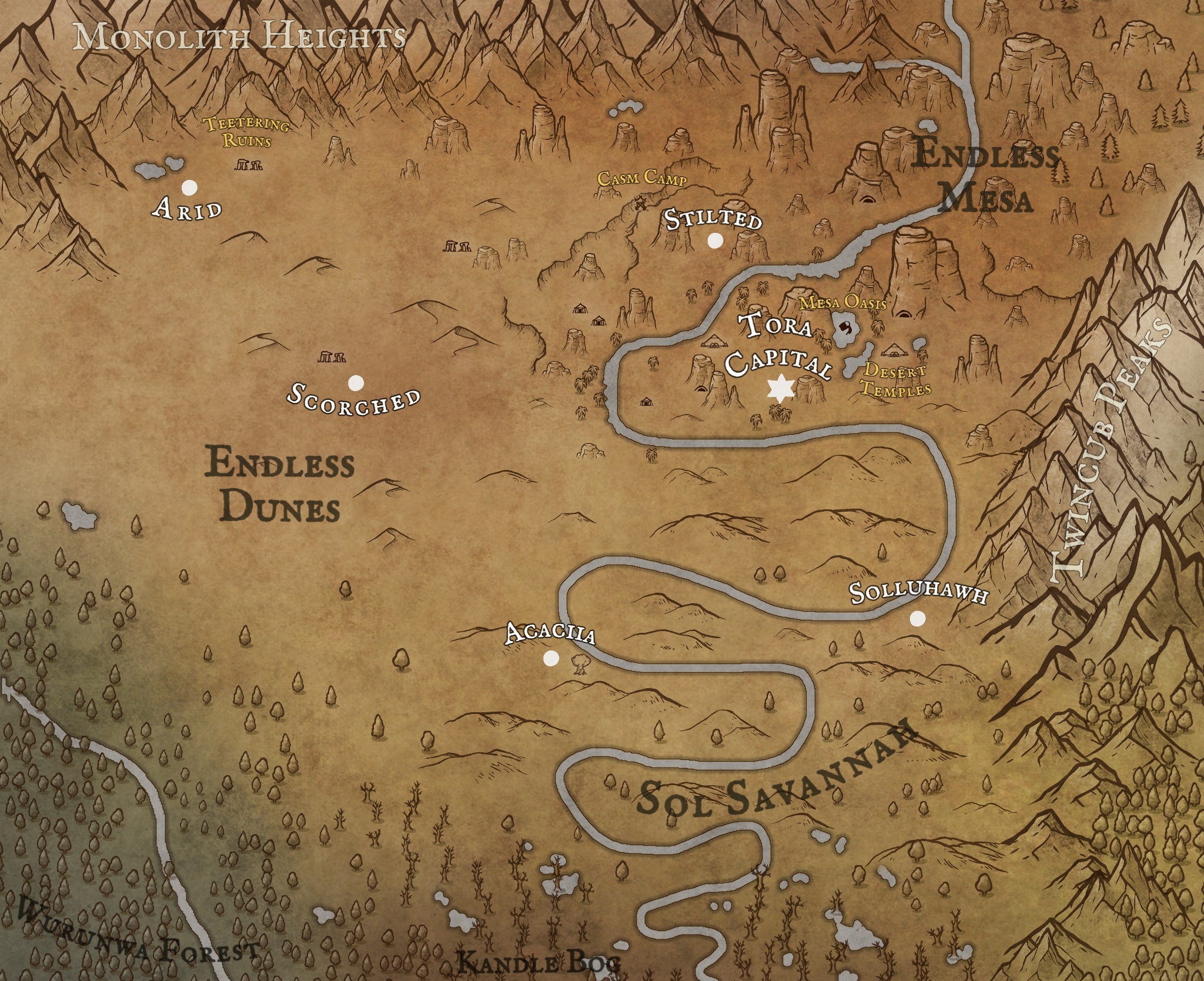
Endless Dunes
In the center of Ptitheros is a desert, dunes blowing smooth forever and clear skies with a warm sun. The Meldra Desert is desolate in many places and is home to some of the most prosperous and rich civilizations in the world. Hardy animals such as karkadanns and sandshufflers are a threat in the beating heat and dusty trails, but reaching the cities is worth every step. Many secrets have been lost beneath the shifting sands.
Castaway
The mid-sized settlement that exists deep within the desert. It sits between two sandstone cliffs and eludes the strong winds of storms by using the natural landform effectively. Unfortunately, sand spills in from the edges above and must be shoveled out often by the residents so as not to get homes or supplies grainy and uncomfortable. Beige and maroon tarps and skins from massive animals make up the walls and ceilings of many of the huts and buildings, all held together by palm wood and carved stone or molded clay dug out from the hearth. Thieves and bandits lurk around every blowing tapestry and the small economy that exists within the loop of minimal trade stalls and hunter markets is unstable due to theft and treachery.
Nomad Camps
They never stay in the same place for too long and set up temporary encampments made of silky tents and comfortable rugs around the center ring that their tents and caravans create to shield from the grainy wind. They have exotic wares and exotic individuals, some are friendly some are not, they are a perfect example of a coin toss decision when it comes to entering their camp in search of supplies or information.
Endless Mesa
A range traveling from the peaks towards the Abscond, high rise plateaus and mesa canyons exist across the desert landscape. Crisp sandstone showing off hues of orange and red with stratified lines catching the eye. These areas of the mesa are littered with small caverns, hidden oasis, and is the most popular place for villages and cities to build upon, as the steppe grants coverage from sandstorms and presents well-needed shade for the creatures of the desert.
Tucruitora - Capital
One of the busiest cities in the world, and richest. Tucruitora was founded by the ancient eastern dragons led by Meldr'uno, until they were cast away, then lefikas were brought in to finish the city. Its buildings are adobe in style, made from finely sculpted clay, mud, rocks, and wood from the savannah southwards. Higher class buildings are covered in beautiful carvings and painted shades of bright sky blue and orange. Tucruitora is a colorful city from the middle district and up, with the palace at the top of the mesa spiral a shining white glaze of beige and gold. In the poorer districts, where caked mud forms trails between huts, it is dull but lively. The city is home to the Tucruitorian monarchy, where the Pharaoh and her children and staff live in the palace and care for ancient sites like the Dome. A structured military and large sandstone wall protects the city from the mesa's lower valley, however the walls have many openings and travel is abundant among the city and its trade market. Some residential sections are built into the mesa cliffs, sustained by aqueducts that flow all throughout the city.
Grand Casm
The Grand Chasm is located west of the Tucruitora capital. It is sometimes called the desert's trench, the Melder's resting ground, or "the big sandy hole". Entrance to the chasm is easy but time-consuming for those who don't enjoy flying downwards rapidly. Trails carved into the walls of the chasm have been made to allow roads deep into the sandstone abyss, and at the bottom a small city has been developed over many centuries. Originally, the Casm settlement was part of the Stilted City, just, the half that was in the shadows of the valley. It was a place where creatures with less heat tolerance could live without fear of the desert Sun above. Everything is lit up with lanterns and torches across the settlement, but it's lively enough to never be too dark like a cavern. The settlement has had many uses in the past, from war steads to abandoned grounds, but nowadays it is the home to the Casm members; a large group of people who wish to not tolerate the current royal rule any longer in the Tucruitora territories.
Hour Dome
Built into the cliffs themselves, is a large semi-circle structure everyone calls The Dome. An open-air gate that functions by pulling down into the ground is the entrance, and the only way to reach the platform it is on high up on the cliff is by flight. Landing on it and getting past the guards, one enters the massive dome structure. Within it is the most decorated building beside the Pharaoh's Throne Room, with many teal stained rocks and a long runner rug of turquoise spilling forward to direct the visitor to the shallow and clear watered pool in the center of the room. The pool glitters and a beam of pure light shines down into the center of it, and yet the pool remains decently cool. All around in the walls are statues of the gods, each upon their hind legs and observing the creature who enters the pool. The Dome has no paintings, no banners, but it does have baskets full of offerings at the feet of the god statues that have been left by worshippers who wish not to ever enter the pool. It is a punishment to enter the pool, often those who are criminals or heretics are pushed into the pool and slowly pulled upwards by the beam of light into a world known as The Hourglass. The Hourglass is a small world disconnected from Ptitheros. It is managed by the hands of the Virtues themselves and is named after its appearance; just being a massive hourglass that floats amongst an endless expanse of clear shallow water far, far below it, whereas the sky above is an eerie pale gray. Those sent to the Hourglass fall through the center coil and into the bottom half, sand is spilling onto them and it is said that there they will be given a test by the gods. If they please they will be sent back, if not, they will be buried and suffocated by the sands of time. Only a few have returned from the Hourglass to say much about it. Those who make it out end up falling from the sky into the endless expanse of the Meldra Desert somewhere, often landing face first into the hot sand. They keep the memories, as the Virtues enjoy watching them go mad with knowing such things the common folk cannot comprehend- thus they watch the "released" victims go mad and just end up in the barracks again.
Stilted
Boulders of red sandstone and granite are balanced on thick, uneven poles of the same stone. It is believed there was once a raging river or an acidic lake beneath the mesa cliffs there, which ate away at the lower levels and left the top halves to hover on thin legs. The Stilted City, exactly as its name implies, is built into the stilted mesa boulders. Hollowed out with rooms and tunnels and windows, a thriving city lies within the rock to avoid the desert heat and vicious weather events. There is less crime, more residents, more families, and more generous personalities to be found within the city. Everyone who lives there has hardly any concept of personal space but are friendly to outsiders who wish to explore or even move into their lovely nature-made home.
Miadus Oasis
A bowl of crisp, turquoise water that sloped underground through a slick, swirling maelstrom at the bottom of the poor. Its source is a beautiful waterfall, showering down from cracks in the mesa cliffside far, far above. A wonderful place to relax, set up camp for a short amount of time, or as a one-stop shop to fill up as many canteens as one could need. However, where there is water there is life. Dangerous creatures of the desert also seek the same precious resources.
Though there are many rumors of its exact location, the ancient caves are burrowed beneath the oasis’ maelstrom. Anything unlucky enough to be caught into its torrent is swept underneath the sands and into a black, inky darkness. Ancient lefikas who are said to have carried treasure had stopped here and carved messages into the rock faces, before the oasis filled. The messages contain a multitude of archaeological wonders, and are even said to carry mysterious powers.
Sol Savannah
The Sol Savannah is just south of the Meldra Desert and is a vast landscape of tall, dry grass that could hide a prowling lefika easily. Tall, sparse, massive trees grow across the fields and most are home to small settlements. The air is crisp, animals are abundant, and it carries a sense of quiet with it, making the Sol Savannah an ideal place to live.
Solluhawh
A warm weather town located south of Tucruitora, where the savanna and vast rolling hills of the Twincub range make up a place of quiet and happiness. Solluhawh is full of homes built into the hills and rocks, a very “hobbit” like town, where families reside in safety, within a community known for its mellow rules and rich markets. Its proximity to the capital makes it a place where materials and helpful exports are readily available at many shops, so citizens can benefit from an easy modern lifestyle but without the noise and danger of the bigger cities.
Acaciia
A town surrounded by savanna and emerging trees. The Kandle Forest sits in the distance and the warm air from the desert blows swiftly through in the evening, casting the town in a bite of dust each day. Acacia got its name from the tree that is entitled to being the key landmark of the town. An extra large savanna tree, called the Acii Tree by locals, its trunk and branches are hollow but strong, holding together much of the town stead within its body. Homes and markets and little farms. The town has grown over time and the tree could not hold them forever, resulting in the settlement spreading outwards from the tree into new sections and farmland that surround Acii and protect it.
Scorchland
The Scorchland is named after its searing qualities. The temperatures and weather there is similar to living in a burning stove. Heatwaves crash across the area of the desert in a constant motion and not even average desert dwelling creatures like Lefikas can survive there without some form of cooling sorcery. Even then, the heat can pressure through the coldest of skins if given enough time. The land is unexplored, unknown, and perfect for rumors and stories to be grown from its mysterious nature. It is said a kingdom almost as old as Chaveri once stood in the simmering mist of sand but now lies in ruin there, stalked by monsters crafted by magma and fuming hostility. The Scorchland is to be avoided; the research is not worth the risk in a land that cooks anything alive. On the outskirts of the area are massive skeletons of ancient dragons, which does attract people to the further edges of the area- never enough to entice them to go further however.
Narndaral "Scorch City"
An ancient Colossal city had survived below the hearth deep within the scorchland. Scalaces had found it long, long ago, and formed their civilization around it. Where the endless sun does not shine, life can exist in the shadows of caverns and rely on minimal amounts of groundwater. Scalaces adapted the ruins of a city to their needs. White ruins became homes, streets, landmarks, and more. With an aesthetic similar to fantasy dwarven mountains, scalace kept their lives away from the landscape above and groups only came out when rarer resources were needed.
Twincub Peaks
Towering mountains separate the Meldra Desert and the East Jungle. Flying over them is dangerous due to their height and the icy environment near the peaks. Tiny settlements can be found amongst the glacial caves. It got its name from the two tallest peaks standing side by side, like twin cubs sitting next to one another.
Maw
Maw is a mountainous, chilly region founded by gryphons fleeing Chaveri. It is renowned for being a safe and peaceful place. It is overseen by a democratic monarchy, headed by an alpha. Although founded by gryphons, Wyndgale is extremely mixed species-wise and culturally. The capital is built around the fossilized corpse of a Colossal.
North Overview
In the northern mountainous region, the primary inhabitants are gryphons with a peaceful culture. They are known as the Galians, who fled from a civil war in Chaveri. They built their new territory in the alpine, guided by a desire for a new life away from the gods. This new land welcomed anyone seeking refuge. Modern Wyndgale is well-organized, with advanced jobs focused on productivity rather than personal gain. The region specializes in seafood, ice, shipbuilding, and unique textiles. The people are self-sufficient. Alpha Pascal, his sister Bleu, and a democratic council lead the territory. The Galians follow a trade-based and capitalist economy under a democratic monarchy. They prioritize self-sustainability and peace.
Galian architecture reflects sociability, sophistication, loftiness, and is inspired by Mankian design. Despite the cool temperatures, clothing is lightweight, with common attire including silken shawls, loose animal-fur coats, and wool sweaters. Relationships are simple: love who you want to love. Wyndgale has the highest ratio of morshin, and most Galians identify as Sagekin, as the territory's founders came from Chaveri, the city of the Sage.
Notes
- Wyndgale is prideful in calling its top leader an alpha. Since the beginning of the kingdom there have been alphas, sometimes one, sometimes multiple. Alphas are raised Galian and are in-tune with the community and culture of their people. Besides nativity, alphas are only required to be part gryphon, so there have many unique alphas. So far, the oldest heir of the previous alpha has taken over, it helps gain favor of other monarchies. The first alphas were the two sibling flock leaders and the current alpha line only connects back to Ichnae.
Wyndgale was officially established as a territory in 1200 C.E. It followed the North Cardinal and was already renowned as a place of peace and prosperity for all species and cultures. Great standings between Wyndgale and Sequ’Manko governments would soon form. Wyndgale began as a beloved, peaceful kingdom and has retained its good reputation. In the old texts, Wyndgale was first an encampment of gryphons who had fled from Chaveri during the Chaveri Civil War. Chaveri was the dragon capital, and the dragon citizens did not want any source of impurity within their home. To escape the danger, a handful of strong fliers went into the highlands where it was said that only nomads roamed free. The gryphons wanted a carefree environment, they dreamed of it, and as generations passed and more gryphons and dragons desiring a new life as well came into the alpine, the more the settlement grew.
South Overview
Chaveri, the original capital of the world, was created by the Sage, the God of the north. The city boasted grand structures, castles, towers, and a network of lush caves underground. It was mainly inhabited by dragons, gryphons, and, for a time, rubasyns before they fled. However, Chaveri's power declined in the late CE era. The city crumbled due to the unchecked power of the god who built it. It sank into the underground cave network, and the god abandoned the surviving people. Those who perished underground became cursed beasts known as windiage.
The Verian architecture of Chaveri influenced designs around the world. It is characterized by its noble appearance, cavernous spaces, intricate layouts, and open planning. The strong and expertly constructed buildings are often used for temples and other secure structures due to their ability to withstand anything. Verians wore dense fabrics with nature-inspired designs, and they had a fondness for ivy-like motifs. All Verians identified as Sagekin because following any other religion in the city of the Sage was dangerous, although not all were loyal to the god.
Notes
The Broken did not remain asleep. At most it takes a few years for a windiage to wake up after death, that's why Chaveri, while it was still functioning after the collapse, were dealing with The Broken already. And for windiages who died after the final raid, they too would only take a few years at most to wake up.
Geography

Gold-eye Prairie
Expansive plains cover the northern edge of the continent. No cities or towns exist there but many small settlements and dwellings dot the landscape. Dull brown-gray grass that reaches the knee sways in the wind for kilometers ahead of where the eye can see. The fields invoke a sense of peace: like all is well in the world, and if not among the cities, then here it will always be calm. Many believe the plains are blessed, proven likely from the main Cardinal temple being situated on the plateau's far east. Dotted across the flat landscape are small "altar"-like constructions; stones shaped squarely sprouting up along pathways of dirt that have faint rune inscriptions covering their base. No texts explain the purpose of these rocks, but with their proximity to the temple, one can only guess they were important.
Sage Altar
The Sage Altar is a large statue carved from stone and petrified wood made to look like the North Cardinal which stands in a clearing just north of the plateau's main river. Although it used to hold a tablet with ancient Draconic texts carved into it, the tablet was stolen long ago and her blank eyes now look down upon empty hands. The tablet's exact current location is unknown but it is said to be hidden away deep in a cave, locked in a collapsed tunnel. Reasons for a Ptithian to hide it away are speculative but one theory states that it might be in relation to anti-Sage propaganda in order to demote the affiliation.
Monolith Heights
Bordering the North Shrine Plateau and Wyndgale territories is a towering mountain range. Believed by all to be the birthing grounds of all landscapes to grow from, Monolith Heights has snow-capped peaks, trails, and roads abandoned and broken, craggy cliffs, and emits the sense of peace from its descending wind and echoes. In the heart of the range is the original Cardinal Temple, where the ancient gods used to meet, discuss, and create.
Architect Temple
One of the oldest buildings in the world. Built from intricately white carved stone from the mountain range it sits within the center of, the temple remains ageless as it stands the test of time and the Monolith Heights' strong winds. Some spires have crumbled and the reliefs of dragons, lefikas, and other ancient individuals of the past have been worn down slightly and dirtied by heavy snowfall, but the inscriptions upon the walls, pillars, and ceilings written in Old Draconic still can be felt and read. A glimpse into the true beginning. The temple only has one massive central room, one with a cylindrical table rising high from the center. Claw marks from the Gods run deep through its stone and ancestral runic symbols scatter the surface. In the old texts it says the table was once a spellspace; glowing with runes and magic that illuminated the entire cathedral without a hint of darkness reaching in. Covering the walls from top to bottom are historic tales of first-hand stories of the Cardinals and their original followers. Small messages from their Collosals and Origin Kin. In small sections even stories about Lindoss are present, making the temple some of the only places in the world where text written in Void can be found and translated. The murals would depict the Cardinals and their early followers, kingdoms, and their early accomplishments. Like Cymer negotiating with Brunos and Edenlline and Swa cooperating on making Chaveri.
Deity Island
Deity island falls under Wyndgale's territory and is a unique and wonderfully dangerous place to live and explore in. High in the sky, the clouds float at the same level as the island and create a sea of fluff just past the grassy plains. The ability to fly is a must here, as the ground constantly cracks and drifts away near the edges and even chunks from the middle of the island sometimes break apart. A spiraling hill grows near the center of the island, home to an ancient ruin at the top and a town at its inner base. Bizarre bismuth-rock cliffs cover the southeast of the island, then drop swiftly into a cascading pit with waterfalls that drop into the ocean.
Highlands
The high-altitude and mountainous realm of the north. The main settlement resides on the edge of where the highlands drop straight into the lowlands as sheer cliffs of crumbling rock. Wyndgale is often viewed as two layers, despite no cliffs of the highlands attached to the lowlands, they often do it in separate and unearthly ways. Arches, towers sprouting from the ground, some flat for miles and miles and others capped in snowy spikes of rubble. It is a strange landscape higher up in the sky, but most Wyndgale folk love to call it home.
Ichy Colo - Capital
The capital city of Wyndgale. Ichy Colo is named after one of the original clan founders known as Ichnae. It sits near the center of the Highlands and is built upon the fossilized remains of a Colossal, its homes are round and ecological within the environment. The city has a large inner market and directly north at the skull of the skeleton is access to Alpha Sentru; home of the Alpha. Its fossilized ribs sprout high into the air and encase the city like an massive open-sky cage, and its tail creates a natural bridge that slopes down the nearest cliff and towards the lowest of the cave den complex entrances. The city itself is even more wondrous than the skeleton, for the buildings are a patchy but pleasing array of woods, soils, clays, and colorful glass. Doors are intricate slabs of wood with a curved handle that always resembles the talon of a gryphon. The residential homes are on the outskirts (still within the rib cage) and climb upwards onto the jutting bones. Small homes and decks perched precariously on the fossilized yet strong towers of bone. Along the spine is the singular line of markets, vendors in tents or busy stalls, sometimes even set up on rugs. Following the spine upwards the bones turn into the neck, where more homes are set up that are bigger and more boisterous.
Foes District
Down the trail, the tail of the skeleton passes by each entrance to the den complex that makes up the inner highland mountain that is near the main settlement. Some entrances are nestled into steep drops, some on gentle slopes. All connect once inside, into a massive web of tunnels that can diverge at any moment. In the dens that line the walls of the residential sections. Fairy lights are strung on the ceiling all throughout and potted burners are in each intersection room. Most intersection rooms are called Brays, they often have small shops set up for food sale and other wares so those near the Bray don't have to travel into the market just to obtain simple necessities.
Plumei
Plumei is a quaint town in the northeast area of the Highlands of Wyndgale. The second smallest town of the kingdom, the place is home to Ptithians who prefer a life not focused on markets and hierarchy; their town has a contained ecosystem of craftspeople, artisans, farmers, and more that often don't export their goods, making the entire town a perfect example of the times before massive trade routes were established and kingdoms fought for materials. However, due to this cut-off lifestyle, the town is a hotspot for activity that prefers to go unmonitored, such as cultist activities and unwarranted spell usage.
Lowlands
The lower altitude prairies of rich green taiga cover the expansive wilderness of the north. They are a beautiful sight, they stretch forever into the silhouettes of the highlands and slope around the feet of the towers to create an ever-wavering landscape that glistens in the sunlight.
Aethe Edge
Aethe Edge is a small town in the Lowlands of Wyndgale. Its architecture is a mix of Galian and Chaverian due to its proximity to the ancient kingdom; it is evident it was once a settlement that belonged to Chaveri before Wyndgale gained control over the territory. The people of Aethe Edge are diverse and live a life mostly detached from the bustle of the cities, only serving as a stop for travelers and traders heading to and from Ichy Colo. Aethe Edge is very close to Skystream Lake, which is its water and prominent food source.
Stormwall
The stormwall is an extremely tall cliff that separates the Lowlands from the Highlands. The cliff stands so tall that only one road has been built to travel up it for Snapp Carriages, all other travel to get over it or to the Foe District city built into it requires flight.
Lost-god Lake
Towards the middle of the Wyndgale territory is a long river that falls over the grand steepness of the Stormwall. This glacial water tumbles down and rushes into the lowlands, flowing into a massive lake known as Sky-stream lake. This lake is said to be an ancient opening to the North Architect’s original underground palace; a place built even before Chaveri came to be. Folklore holds up, there are caverns beneath the lake that bring the water out into the ocean and into groundwater tables, however the presence of a lost god palace is undiscovered.
Seaside
A clan living next to the ocean in a quiet fishing-based community. They have good connections to markets within Wyndgale so they tend to be the most talked about/rumored and dissed due to their unwarranted publicity. They deal with hunters and cultists more than any other beastial clan and have become very strong in their defenses, as they are willing to use their power to protect anyone in their clan. Seaside also welcomes non-werebeasts, however the individual must have a reason to live there, such as being prosecuted for something else or are stuck as a societal outcast.
World's Maw
Said to be the mouth of the world due to its shape and location on the Ptitheros continent, the World's Maw is a geological marvel carved from erosion over millions of years from the harsh waves and wind of the northern ocean. The cliffs of the Maw rise high above the sea-level, overlook the vast distance, and often have a layer of clouds grazing the soft green grass of the landscape. Storms with strong wings and salty air are frequent, but it does nothing to push people away. Flight fishers, divers, and more dot the cliff sides each day, making the location popular with tourists, bringing money and population to the towns of Plumei Santos and Maw's Clutch.
Clutch
The Clutch is a town settlement found on the south edge of the World’s Maw. It lies a couple miles away from the sheer edge, making it a very sea-breeze ridden place that has a culture deeply influenced by the Maw itself. Life revolves around the edge, as glide fishing and farming wind-resistant crops is essential to the people there. Although the weather is tough, the people have the same calm and resistant attitude that is common in Galians of all kinds.
Ichnae's Retreat
An ancient prayer ground. It hides in the foliage in the northeast near Plumei, a cold swamp having overtaken it. Statues of gryphons, one that looks like Ichnae, cover the area, some barely holding their head above water. The crumbled temple was a cooperative effort between Sagekin and Sequn, evident by some Sequn symbols and architecture found mixed in. Strangest of all, the mire grows beautiful quartz crystals like a regular pond would grow cattails. These crystals are harvested for religious worship and rituals.
Honeycomb Forest
A dangerous forest that fills the northeast of Ptitheros just before the altitude of the landscape rises, the honeycomb forest is full of dense trees. These trees have porous trunks, their roots can grab animals, and their canopy resembles hardened honey rather than leaves. The honeycomb forest becomes denser in some areas; these zones closer to the World's Maw are called the Aurix Caesin.
Broken Plateau
A landscape that covers the southwestern zone of the honeycomb forest, the plateau was once home to many of the trees but over time became sporadic in its growth. Trees decayed and never grew, the grass became thin and fossilized right after death, then the ground began to break apart. A curse upon the land, the area was once a prized hunting ground for the kingdom of Chaveri, but when the kingdom fell, much of the landscape it called home also fell into disrepair. The plateau has trenches and cracks everywhere, making the lands a dangerous place that must be explored carefully, for falling into a crack would bring a victim into the many caverns that loop throughout the Aurix region.
Ruins of Chaveri
The Aurix region covers a vast maze of caverns that have openings on the surface and can travel all the way down to the subterranean magma zone (close to the first mantle layer). Underground rivers, underground lakes, underground growth, the caverns have many mysteries to uncover and explore. Somewhere within the vast complex are what remains of the Chaveri capital, its ruins standing the test of time in the stagnant environment of the cavern systems. Its residents, too, roam the caverns to this very day. Most Ptithians know these ancient residents as windiages.
Heart of the Hive
Somewhere in the deep, deep dark depths of the Honeycomb Forest lies a large honeycomb tree. Its roots span for over a kilometer and dig deep into the forest floor. Rusty orange water pools between the roots and feeds the ancient tree. Weather does not affect this small, strange area of the forest, but a faint pulsing sound can be heard coming from the tree’s trunk. It feels like something more alive than a mere plant is there, but nobody dares cut into the tree. Very few have laid eyes on it, let alone escaped the forest after venturing so far into the Bramble Maze just to see it.
Ruins of Aurix
When the caverns the Aurix Clan called home collapsed deeper underground, the dwellings and daily life came to an abrupt stop. Venturing into the sinkhole chasm that so many Aurixians once called home, one is met with the crumbled remains of smashed furniture, cabinets still full of preserved food, scratched doors as the Ptithians tried to claw their way to freedom, and the crushed skeletons with bones either cracked or scattered beyond recognition.
Manko
The territory was crafted by Cymer and was one of the three origin kingdoms. In the past, they had a tribalistic nation, but they advanced rapidly while remaining reliant and sustainable with their environment. It is one of the most peaceful and educated cultural regions in Ptitheros. Known for its beautiful, towering tree architecture and endless turquoise rivers. Its massive temples, pyramids, ruins, and grand college of Mau.
Overview
In the far west, there's a shoreline and delicate rainforest. It's mostly inhabited by dragons, but there's a mix of species with a peaceful and educated culture. The region was originally created by Cymer, but the Architect disappeared, leaving the inhabitants to develop on their own. Despite past racial attacks, Sequ’Manko has recovered well and is now stronger than ever, restructured and prepared. There's a lot of activity in the region.
Modern Sequ’Manko is well-organized, with advanced jobs focused on productivity rather than personal gain. The region specializes in agriculture, lumber, textiles, glasswork, and medicine. The Mankians follow a trade-based and capitalist economy under a social-crafted theocratic-democracy. They prioritize citizen happiness and sustainability. The leadership consists of a president and a council of appointed shamans.
Mankian architecture is lofty, self-sustaining, nature-oriented, and exotic. Mankian clothing includes accessories like ponchos, beaded ascots, shawls, twine jewelry, turquoise, and lightweight bracelets. Relationships are important, and monogamy is highly valued. While the regional religion is Sequn, many lineages had to hide their religious beliefs due to the anti-Semitic war. Mankians have a mix of Sequn, Swavvel, and Architectism influences.
Notes
Community based and culturally bonded, Cymer and Mankians never enacted a monarchy like the other kingdoms. Cymer appointed shamans and a lead shaman during the early years of the kingdom, since then, Manko has always had a council of shamans who handle the theocracy aspect of the government. The lead shaman eventually became the chieftain's bloodline, and the council handled Manko as its form of lawmakers until the early C.A. era. As Ptitheros became increasingly connected and borders broke down, Manko knew it needed to reform its government into something more secure, something that could defend itself. A tight democracy was created to run alongside the shaman council. Leading the democracy side is a president, typically someone related to the Chief bloodline, even if not direct. During the Raining Fire attack, the last real Chief was killed. His daughter never assumed control, nor has her son. The Mankian Chief direct lineage is still alive, but currently is not involved in the government. The shaman council is constantly trying to reign them back in.
The Manko region has a civilian army. Soldiers and guards are trained in combat to defend the territory in a generalized way rather than as a proper militia. They keep the city, towns, and loose borders safe from lieges and major monster threats. They work more like police. Manko defenders are best known for their skills on brister-back, able to move through the jungle at a deadly silent and quick pace.
Geography

West Jungle
A beautiful shade of green, dense greenery grows among the jungle, trees rise far into the sky, and the rivers that spiral through the land are a crisp, soothing teal. An abandoned kingdom rests near the coast, many smaller tribal communities are found down its overgrown roads. The West Jungle used to be home to many prosperous creatures and trade, but now it stands as a testament to what becomes of hatred.
Sequelliyphs - Capital
Sequelliyphs is one of the oldest civilizations on Ptitheros. Crafted intricately by the West Cardinal, Cymer, and his kin, Sequelliyphs makes full use of the dense jungle around it, the massive trees, and the large Dorr’Ko Lake amidst the center of it. It is a grand place full of life and activity, one of the largest cities of its time and second in line to being the most technologically inclined (the first being Nox Capital). It is the capital city of Sequ’Manko. The jungle climate brings rain and thunderstorms, allowing wet agriculture to thrive and the river/lake to swell with fishing and hunting. Clean water comes from the natural grotto springs all around the lake, fountains line many plazas across the city and glow with enchanted fire pits at the top during the night.
Old World Ruins
Sequendalar was a small town to the east of Sequelliyphs. It was the very first settlement of Sequ’Manko and holds a lot of historical significance. Home to many traditional sites and small Sequn museums, it also has some sections where generational families live. These families are some of the longest lasting Sequn heritages, many having direct ties to assisting the West Cardinal in the distant past. The west side of Sequendalar was the target for the cults that caused the Great Fire, for their intention to kill many traditional Sequns and the most important historical sites using fire and fighters. Sequendalar is empty, ash covers the dirt roads, blood paints wooden stakes placed across the ground.
Cyme Palace
Protected in the heart of the capital city, the god's grand palace is barred off except for the outer courtyards. Golden columns and silken tapestries blow in the wind. Intricate carvings cover the walls and plants curl around edges that have not moved or grown since Cymer left. A pool of crystal clear water rests in the courtyard entrance, its reflection like a perfect mirror. Not even researchers are allowed into the palace, Mankians are afraid it would make Cymer angry.
Sequano
Sequano is a large town in the depths of the West Jungle. It suffered greatly when the capital of Sequ’Manko went under, but recovered in the next decade or two. The architecture of Sequano is almost exclusively in the canopy and mid-layer of the massive jungle trees. Bridges and ziplines connect complexes of round wooden buildings, but flight is the easiest way to traverse. Farms are up in the trees, rainwater is collected for drinking water, and the only structure on the ground is a dock port along the river below it to allow for ships. Sequano is predominantly Sequn, but allows all kinds of Ptithians to live and thrive.
Whisper Glade
In northwest Sequ'Manko is an emancipation temple with a massive statue of an unknown worshiped creature. It does not completely resemble depictions of the West Cardinal so it is assumed to be something else, which confuses those who have spent time studying the monument. The monument is a circular temple, similar to the Dome in Tucruitora, but on a much smaller scale and made from andesite blocks, pillars, and crystallized glass that has a composition as if it were made of pure sugar. The purpose of the temple and who built it is unknown at the time, records of the temple and its surrounding area being searched for in the Ancient Archives.
Steam-Wrought
On the far west edge of Ptitheros is a jutting peninsula covered in dense foliage that grows as a healthy pale green. The humidity here is unbearable, rainstorms are common and hardly anybody can be found inhabiting the sickly-humid jungle besides minituries and dangerous insects. Ruins of past Mankian temples can be found around the east edge of the steam jungle, likely built before the entire peninsula was impossible to navigate.
Mau'zun Mountains
Bordering the western jungle and the dark briar grove is a large mountain chain that reaches around 2k m above sea level. Although short compared to the mountain ranges, Mau'zun makes up for it by being a beautiful location full of thick forests and the rising hills covered in jungle greenery, along with an interesting steppe pattern sloping up its sides. Many old mines can be found at the southern base of the range, as it used to be a goldmine for rare jewels.
Selin'bu
Selin’bu is a village in the humid mountains. It has always been quaint and its major draw is how simple life tends to be there. Natural skillsets and a survivalist mentality is common, but the community is always there to assist. Selin’bu shows exactly what it means to be a proud Mankian. The people there are kind, helpful, but are very territorial over their traditions and will not take criticism about their culture or Cardinal. They are not against technology, but choose not to make it part of their lives.
Cyme Ruins
There exists a room near the entrance halls of the Cyme Ruins that warps one's perception so much it causes insanity or enlightenment. It was originally blocked off and used as a judgment room for the West Cardinal to use on His kin. Those who came out with enlightenment tell of seeing into the world of Lindoss, feeling the thoughts of those in Sallenin, and knowing a higher meaning to their life and love. Those who exit with insanity were left to wander, often getting lost and dying in the underground temple after being abandoned by their god.
Tome of Parallm
Deep in the mountains, part of the Cyme Ruins, is a gateway carved from pure turquoise, azurite, and an unknown pulsating teal substance similar to moss. Voidscript and carvings like those found in the darker Cardinal Temple rooms are found all over the rock. Sometimes, the gateway opens a smidge, a cold breeze blows from the endless darkness inside. Mankians have wondered what lies beyond it for centuries.
Karst Coastline
At the northern edge of the West Jungle towers a region of karst formations that broke away from the Mau'zun range long ago. These karst mountains thrive with tropical plants that grow up the rocky columns. The region is home to the Ironbramble settlement and some tourist spots. Thin, wooden bridges sway from point to point across the cloud-hazed peaks. Its windward angle to the Mau'zun Mountain range traps rainfall and powerful tectonic motion from before the Pre-history era formed the unique and dangerous landscape.
Blue Tropics
The farthest west coast of the jungle is filled with small islands, limestone cliffs, beautiful teal waters and full-of-life barrier reefs. These islands stretch all the way to the archipelago and are home to many unidentified species. The coast and islands nearby are home to many resorts and fishing spots.
Seree'yaa
Seree’yaa is a large town on the west coast of the West Jungle. A port town, much of its architecture is structured to flow from the smaller jungle trees and out onto the docks that sit atop the teal ocean waters. Seree’yaa was independent before the war, so not much has changed in the town. Ships come in and leave day in and day out. The calming waves flow over the sand and palm trees sway. The small islands off the coast of the Artemine can be seen from the shore. Seree’yaa is a peaceful place to live and has opportunities and connections available for all sorts of occupations and cultures.
Where the Rings End
Along the pristine and clear waters of the Mankian shallows remains an odd sight. Jutting hundreds of feet into the air, waves crash along the base and all seabirds keep distance from 6 monolithic structures. These structures take form in the shape of towering rings made of an unknown stone, for the substance does not match anything geologists have ever seen, but resemble a smooth marble. The rings are not disturbed beyond flying nearby, as accidentally stumbling within can lead to a grim fate. The second an unfortunate Ptithian flies or swims within the rings they will feel as if the water has inverted itself, the world spinning around them as their brain fumbles to make sense of what is happening. The 6 rings turn into 10, then 100, then stretch on into what looks like forever. It is rumored they have an end but no one has documented such, and those who claim to have been to the end are brushed off as insane. It is thought that the rings are connected to the Caves of Time due to the odd 'inversion' of water once within the rings' influence, though this connection hasn't been seriously studied. The odd properties of the zone make it a discussion question, though studies of it have halted for an unknown reason.
The Cosmos
Planetary Basics
Year Length & Seasons
- Orbits at 50 AU from its A-type star, Ptoulu.
- Inner edge: 46.39 AU, Outer edge: 74.20 AU.
- A year is 390 days long.
- A solar day is 24 hours.
- Four seasons: Onkmet (Winter), Vern (Spring), Erthnetora (Summer), Grikad (Autumn).
- Each season lasts ~3.25 months; a year has 13 months of ~30 days each.
- Seasons begin after specific eclipses:
- The Sage’s Eye (North) → Onkmet (Winter)
- The Melting Sun (East) → Vern (Spring)
- The Swaying Moon (South) → Erthnetora (Summer)
- The Blue Star (West) → Grikad (Autumn)
- Similar mass composition to Earth but much larger to accommodate massive creatures, vegetation, and geological formations.
- Gravity is slightly lighter than Earth's, allowing for larger lifeforms and widespread flight adaptations.
- Due to the A-type star, many species can see into the UV spectrum. UV vision can be activated on demand, aiding in night vision while keeping daytime vision within the visible spectrum.
- Oyx: The primary, tidally locked moon with a monthly revolution period.
- Nyx: A captured asteroid, tidally locked, with an 'almost' monthly revolution. Nyx is viewed as an imperfection that embodies beauty, despite its irregular shape.
Space Sector
Ptithians are a space-dominant race, and they have the option to live their entire lives exploring the galaxy on space stations. Zariel and other space sectors have developed their own unique culture in this new environment. Station Zariel is designed with various sections for different purposes, including public areas, private wards, health branches, science branches, and authority branches. Navigating the entire station can be challenging without a map, but most residents spend their time in the public zones or their occupational branches. The hub level is where daily life happens, with numerous shops, restaurants, and places to relax or socialize when not working. Anyone can open a business as long as they have a permit. Depending on their job, ptithians report to specific wings on the station: scientific jobs on the aura level, businesses on the hub level, and administration jobs on the authority level. Space architecture is designed to blend with nature, using organic materials and strong metals to accommodate the natural flow of aura. Station residents typically wear diage spacesuits, and they can personalize their attire with accessories like tail-bags, belts, and goggles.
Station 001 Zariel - All Ptitheros spacecraft, including stations, pods, and more, are built out of natural materials and an allumnix hull to replace anything that cannot be encased with wood, glass, stone, or plant life. Station 001 Zariel was a joint effort between the major kingdoms so that Ptitheros as a whole could have an area claimed in space. Station 001 Zariel is symmetric and crystalline in shape, designed to mimic the architecture of the Call Points and Archive central rooms as homage to the Cardinals who designed the ancestral architecture. The station comprises three main levels, the Authority Level, the Hub Level, and the Aura Level.
Lindosts are necessary on almost every space ship except Voyagers because their aura control is needed to handle the energy and core of the larger vessels. Such as, whenever a group is sent out on a Chimera or Aurora, one lindost is paired with them. Or, on Station Zariel, many can be found in the Aura Level of the station because they handle anything with the orb core. Lindosts who work with Ptithians and their space needs are usually there on their own terms because it interests them greatly in comparison to their usual 'job'. Ptithians who work space occupations have to get over their deep-set, natural fear of lindosts quickly if they wish to stay in the line of work.